Problems of Studying the Secret History of the Mongols as a Historical Source
Research Article
DOI:
https://doi.org/10.65076/3105-0042.2026.4.86.121Keywords:
The Secret History of the Mongols, historiography, source studies, dating, colophon, anachronisms, Altan TobchiAbstract
The article examines the historiography of studying The Secret History of the Mongols as a historical source. The main focus is on the debated issues of the dating of the monument, the problem of the colophon, authorship, and the process of text formation. On the basis of a comparative source analysis of works by researchers of the 19th–21st centuries, key anachronisms and politically motivated plotlines are identified. It is shown that none of the proposed datings (1228, 1240, 1252, 1264, 1324) is consistent with all the data of the colophon and the content of the text. The necessity of considering the colophon as part of the historical narrative and conducting a detailed literary-historical analysis of the plots in comparison with the Yuan chao bi shi and the Altan Tobchi is substantiated. The materials of the study include the text of The Secret History of the Mongols, considered in comparison with data from the Yuan shi, Rashid al-Din, Koryŏsa, Altan Tobchi, Sheng-wu qin-zheng-lu, and other sources used by researchers to address questions about the origin, dating, structure, and character of the monument, as well as studies devoted to this historical source. The main method is historiographical and comparative source analysis. Proposed datings and reconstructions of the text’s formation, their argumentation, identified anachronisms and contradictions, as well as textual and historical-geographical observations, are examined. The literature review traces the evolution of scholarly views on the time of the monument’s creation. It is noted that for a long time the dating to 1240 did not raise doubts; however, subsequent studies revealed serious contradictions. Hypotheses linking the text to the kurultais of 1228, 1240, 1252, 1264, and 1324 are analyzed in detail. It is shown that proponents of each version have to resort to complex assumptions in order to reconcile the colophon with the rest of the text. Particular attention is paid to the analysis of anachronisms present in all parts of the work, including the description of Ögedei’s reign and earlier sections. Examples are given of plots connected with Shigi Qutuqu, Muqali, Mahmud Yalavach, Chormaqan, and the conflict between Batu, Güyük, and Büri. It is indicated that these plots could not have arisen in 1228 or 1240 and reflect the political realities of a later time, primarily the era of Möngke and Kublai. In the discussion, it is emphasized that the question of dating, authorship, and the process of text formation deserves a separate monographic study. The most promising direction is recognized as considering the colophon as a full-fledged part of the historical text, as well as a detailed comparison of the Yuan chao bi shi and the Altan Tobchi in order to identify insertions and editorial changes. The need for literary and historical analysis of individual plotlines, and not only linguistic textual analysis, is pointed out. In conclusion, it is stated that the discussion remains unfinished, and none of the proposed Years of the Mouse corresponds to all the conditions of the colophon.
Downloads
References
Atwood C. Informants and Sources for the Secret History of the Mongols. Mongolian Studies. 2007. No.29, рp.27–39.
Atwood C. The Date of the ‘Secret History of the Mongols’ Reconsidered. Journal of Song-Yuan Studies. 2007. No.37, рp.1–48.
Atwood C. Alexander, Ja’a Gambo and the Origins of the Image of Jamugha in the Secret History of the Mongols. In: Neilu Ouyalishiwenhuaguojixueshuyantaohuilunwenji. Edited by Teligeng [Terigün] and Li Jinxiu. Höhhot: Inner Mongolia People’s Press, 2015. Pp.161–176.
Atwood C. The Indictment of Ong Qa’an: The Earliest Reconstructable Mongolian Source on the Rise of Chinggis Khan. Historical and Philological Studies of China’s Western Regions. 2017. No.9, рp.267–302.
Atwood C. Rashīd al-Dīn’s Ghazanid chronicle and its Mongolian sources. In: New Approaches to Ilkhanid History. May, Timothy; Dashdondog, Bayarsaikhan; Atwood, Christopher P. (eds). Leiden; Boston: Brill. 2020. Pp.53–121.
Grousset R. Etat actuel des études sur l’histoire genghiskhanide. Bulletin of the International Committee of Historical Sciences. 1941. Vol.12, рp.22-40.
Hung W. The Transmission of the Book Known as The Secret History of the Mongols. Harvard Journal of Asiatic Studies. 1951. Vol.14, no.3/4, pp.433–492.
Ledyard G. The Mongol Campaigns in Korea and the Dating of The Secret History of the Mongols. Central Asiatic Journal. 1964. No.9, pp.1–22.
Ligeti Lajos (ed.). A mongolok titkos története. Fordította Ligeti Lajos, a verseket fordította Képes Géza. Budapest: Gondolat Kiadó. 1962. 241 p.
Mostaert A. Sur quelques passages de l'Histoire secrète des Mongols. Harvard. Journal of Asiatic Studies. 1950. Vol.13, no.3/4, рp.285–404.
Okada Hidehiro. The Secret History of the Mongols, a Pseudo-Historical Novel. Ajia Afurika gengobunkakenkyū. (Journal of Asian and African Studies) 1972. Pp.61–67.
Okada Hidehiro. The Chinggis Khan Shrine and the Secret History of the Mongols. Religious and Lay Symbolism in the Altaic World and Other Papers. Edited by Klaus Sagaster and Helmut Einer. Wiesbaden: Otto Harrassowitz. 1989. Pp. 284–292. (In English)
Pelliot P. Deux lacunes dans le texte mongol actuel de L’Histoire secrète des Mongols. Journal asiatique. Mélanges asiatiques 1. 1940–41. Vol. 232, рp.1–18.
Rachewiltz I. de. Some Remarks on the Dating of the Secret History of the Mongols. Monumenta Serica. 1965. Vol. 24, рp.185–206.
Rachewiltz I. de. Brief Comments on Professor Yu Ta-chun’s Article ‘On the Dating of the Secret History of the Mongols’. Monumenta Serica. 1986–87. Vol.37, рp.305–309.
Rachewiltz I. de. The Secret History of the Mongols: A Mongolian Epic Chronicle of the Thirteenth Century. 2 vols. Leiden: Brill. 2004. 1347 p.
Rachewiltz I. de. The Dating of the Secret History of the Mongols - A Reinterpretation. Zeitschrift für Uralische und Altaische Forschung. Ural-altaische Jahrbücher. 2008. Vol. 22–35. Pp.150–184.
Ratchnevsky P. Šigi Qutuqu In: In the Service of the Khan. Edited by Igor de Rachewiltz, Hok-lam Chan, Hsiao Ch’i-ch’ing, and Peter W. Geier. Wiesbaden: Otto Harrassowitz. 1993. Pp.75–94.
Waley A. Notes on the "Yüan-ch'ao pi-shih". Bulletin of the School of Oriental and African Studies. University of London. 1960. Vol.23, no.3, pp.523–529.
Yu Da-djun [Yu Dajun], trans. Wilhelm K. Mueller. On the Dating of the Secret History of the Mongols. Monumenta Serica. 1986–87. Vol.37. Pp. 277–303.
Uno Nobuhiro. Comparative Analysis of The Secret History of the Mongols and Jāmiʿ al-Tawārīkh as Sources for the Study of Genghis Khan’s Early Life. 2009. No.7.
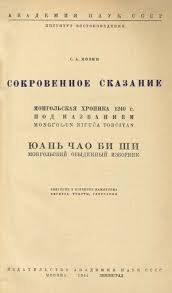
Kozin S.A. Sokrovennoe skazanie. Mongol'skaja hronika 1240 g. Vol.1. 1941. Moscow: AN SSSR. 611 p.
Porsin A.A. Dzhuchi. Nesostojavshijsja naslednik. Astana: “Mezhdunarodnyi nauchnyi kompleks ‘Astana” 2023. 392 p.
Downloads
Published
Issue
Section
License
Copyright (c) 2026 А. Porsin

This work is licensed under a Creative Commons Attribution-NonCommercial-NoDerivatives 4.0 International License.