Empty Space on the Map: Rethinking Communication Networks of the Golden Horde Era in History Textbooks
Research Article
DOI:
https://doi.org/10.65076/3105-0042.2026.4.122.136Keywords:
Jochid Ulus, Golden Horde khans, Northern Kazakhstan, communication network, yam system, caravan routes, historical geography, history textbook, GIS, steppe civilizationAbstract
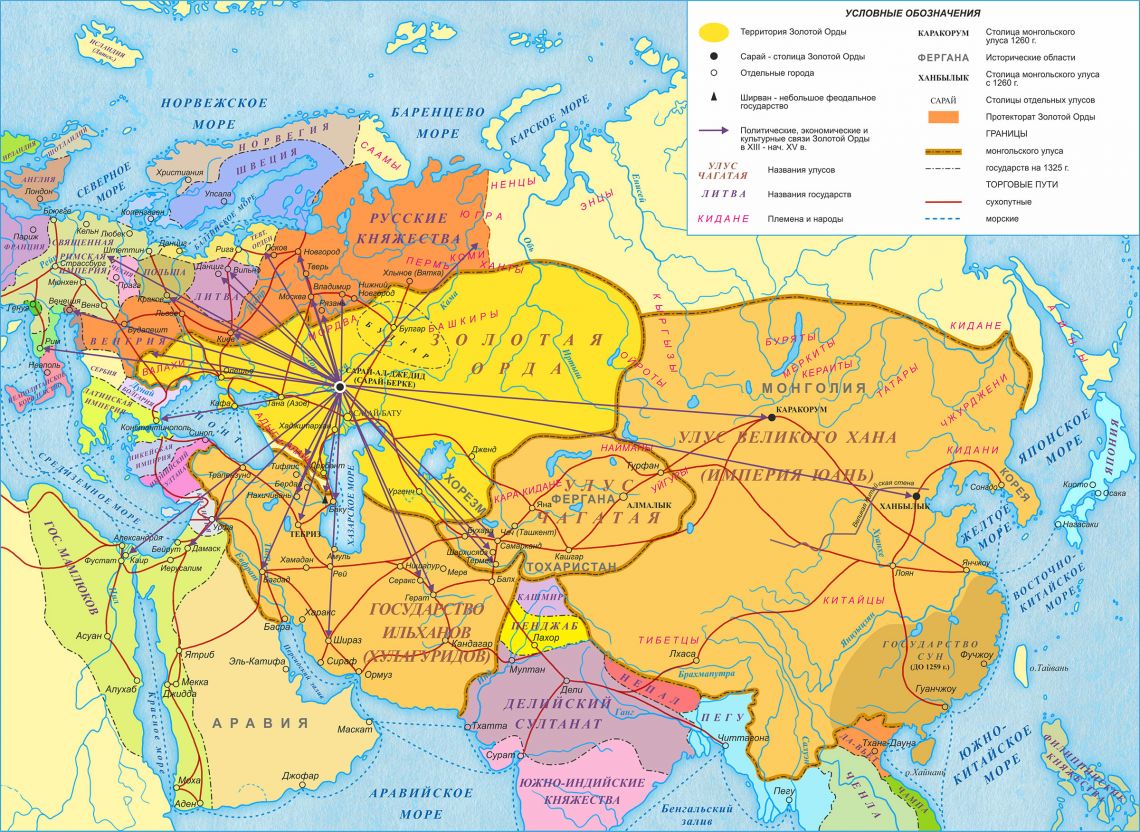
This article reconsiders the place of Northern Kazakhstan within the political, trade-economic, and cultural communication networks of the Jochi Ulus from the perspectives of historical geography, source studies, and textbook research. The main objective of the study is to identify the limitations of the traditional interpretation that represents the region on historical maps as peripheral, “empty,” or exclusively nomadic space, to reveal its role within the interconnected communication system of the Golden Horde, and to propose a scholarly and methodological model for representing this issue in history textbooks. The study draws on written sources, archaeological and numismatic materials, historical-geographical data, toponymic evidence, cartographic materials, and research on the representation of Golden Horde history in textbooks. Historical-comparative, historical-geographical, interdisciplinary, and content-analysis methods were employed, together with the analytical potential of historical GIS. The study identifies three interconnected dimensions of communication in the Golden Horde period: political-administrative, trade and transport, and socio-cultural. The yam system is examined as a form of state infrastructure that facilitated the circulation of information and the movement of people across the vast territories under khanly authority. The article also outlines possible corridors linking Northern Kazakhstan, through the Ishim, Tobol, and Irtysh river valleys, with Central Kazakhstan, the Syr Darya region, the Ural–Volga area, and Western Siberia. Particular attention is paid to the role of water sources, seasonal pastures, security, political stability, and exchange centres in the formation of caravan routes. The article further analyses changes in the representation of the Golden Horde in Soviet and contemporary textbooks and argues for a shift from evaluative interpretations toward structural explanation. The study does not claim that the exact locations of all routes and yam stations in Northern Kazakhstan have been established. Instead, it proposes distinguishing between different degrees of source reliability as an important methodological principle. Accordingly, the map is treated not as an illustration of a fixed historical reality, but as a scholarly reconstruction produced through the comparison of different categories of evidence. The conclusion recommends constructing textbook maps according to a network-based principle, distinguishing verified, probable, and hypothetical sites, and displaying chronological layers, water sources, seasonal routes, and levels of evidentiary uncertainty. Such an approach allows Northern Kazakhstan to be understood more fully as an integral component of the interconnected historical space of the Jochid Ulus in Central Eurasia.
Downloads
References
Abzalov L., Gatin M., Mustakimov I., Pochekaev R. K istorii obespecheniia bezopasnosti torgovykh putei v chingizidskikh gosudarstvakh XІІІ-XIV vv. Materials in Archaeology and History of Ancient and Medieval Crimea. 2022. №. 14. Pp. 297-313. DOI: 10.53737/2713-2021.2022.89.86.014 .
Abliazov K. A. Tekhnologii GIS pri rekonstruktsii torgovo-transportnoi sistemy Zolotoi Ordy. Izvestiya of Saratov university. New series. Series: Earth sciences. 2023. Vol. 23, no. 3, pp. 144-146. DOI: https://doi.org/10.18500/1819-7663-2023-23-3-144-146
Beliaev D., Shkurat P. Istoriografiia, izuchenie istochnikov i metody istoricheskikh issledovanii. Manuscript. 2026. Vol. 19, no. 1, pp. 14-22. DOI: https://doi.org/10.30853/mns20260001 .
Vorotyntsev L.V. "Tatarskii torgovyi put" ("Via Tatarica") v mezhdunarodnoi torgovoi sisteme XIII-XV vekov. Golden Horde Review. 2019. Vol. 7, no. 1, pp. 77-89. DOI: http://dx.doi.org/10.22378/2313-6197.2019-7-1.77-89. .
Skripkin I. N., Beliaev D. A., Shkurat P. A. Dinamika otrazheniia i problema interpretatsii temy "ordynskaia zavisimost Rusi" v sovremennykh uchebnikakh po istorii Rossii: istoriograficheskii analiz. Manuskript. 2026. Vol. 19. no. 1, pp.14-22. DOI: https://doi.org/10.30853/mns20260001.
Iliasova Z., Nogaibaeva M. Informatsiia Al-Omari ob istoricheskoi geografii Zolotoi Ordy. Turkic Studies Journal. 2024. Vol. 6, no. 3, pp. 51-68. DOI: https://doi.org/10.32523/2664-5157-2024-3-51-68.
Koshechkina E.A. Ulus Dzhuchi v sisteme mezhdunarodnoi torgovli na territorii Krymskogo poluostrova v XIII-XIV v. Omsk scientific bulletin. Series "Society. History. Modernity". 2020. Vol. 5, no. 2, pp. 22-28. DOI: 10.25206/2542-0488-2020-5-2-22-28
Merich S., Pashaoglu D. D. Pochtovaia organizatsiia (iam) v Zolotoi Orde. Golden Horde Review. 2023. Vol. 11, no. 1, pp. 37-61. DOI: http://dx.doi.org/10.22378/2313-6197.2023-11-1.37-61
Downloads
Published
Issue
Section
License
Copyright (c) 2026 Zh. Smakhanova

This work is licensed under a Creative Commons Attribution-NonCommercial-NoDerivatives 4.0 International License.