
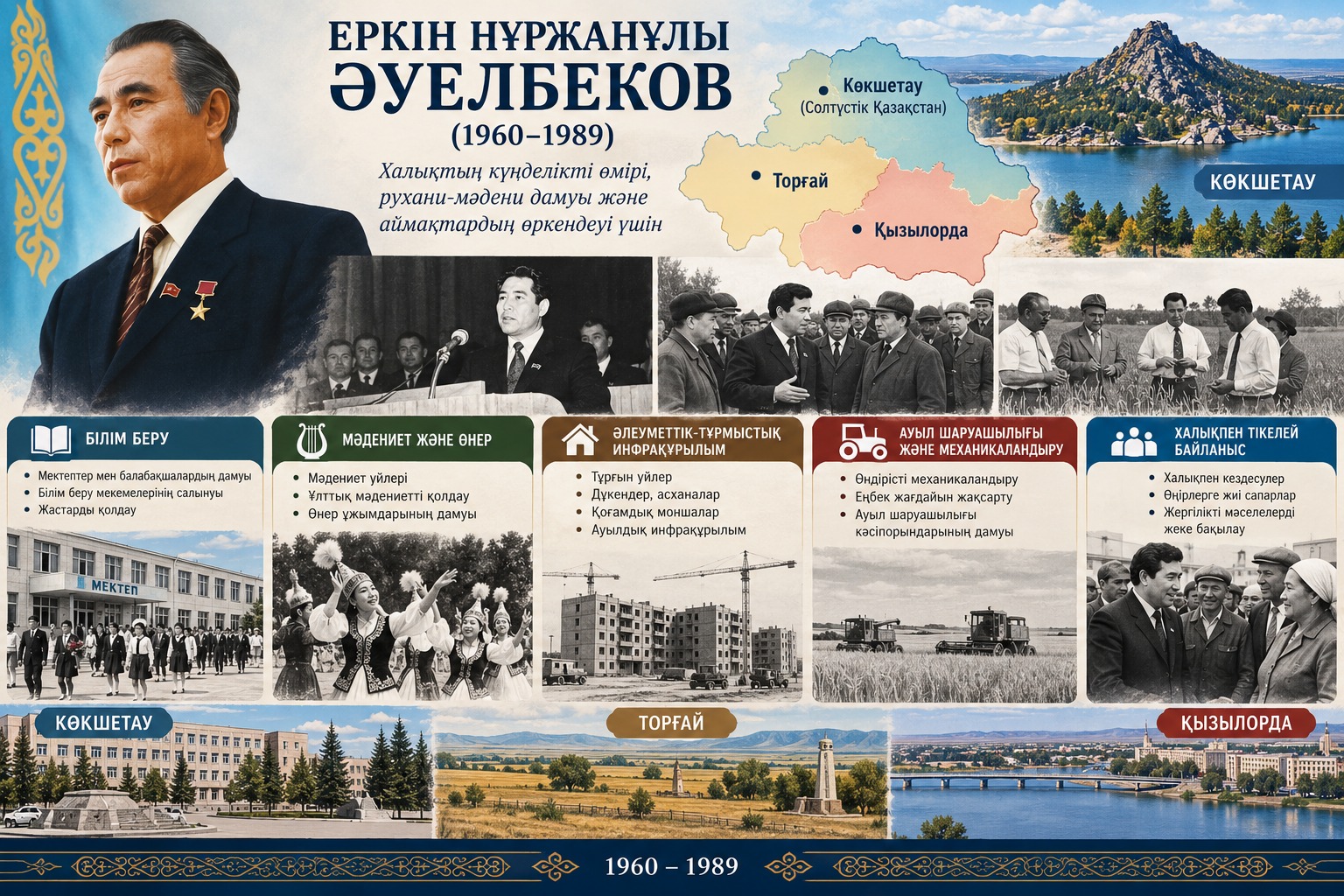
The role of Yerkin Auelbekov in the spiritual, cultural development, and everyday life of the regional population during his leadership (1960-1989)
Research Article
DOI:
https://doi.org/10.65076/3105-0042.2026.4.137.155Keywords:
Yerkin Auelbekov, everyday life, socio-domestic conditions, cultural development, national culture, historical memoryAbstract
The article investigates the impact of the prominent Soviet-era state and public figure, Yerkin Nurzhanovich Auelbekov, on the daily lives and spiritual-cultural development of the population in the regions under his leadership. Although various memoirs, journalistic pieces, and individual research articles focusing on E.N. Auelbekov’s socio-political and state activities have been published over the years, his relationships with ordinary citizens and his efforts to resolve social, domestic, and cultural issues have not previously been subject to a comprehensive, targeted study. Consequently, this article examines Auelbekov's career not merely through the lens of a traditional political biography, but through the framework of its practical effect on the daily lives of the population. The empirical foundation of this study draws upon documents from the State Archives of North Kazakhstan Region, the State Archives of Kostanay Region, E.N. Auelbekov’s personal fund at the State Archives of Kokshetau, and the Archive of the President of the Republic of Kazakhstan. Alongside archival records, the research incorporates periodical print media spanning several decades, as well as memoirs from state and public figures, party-Soviet officials, colleagues, and ordinary workers who personally knew or worked with Auelbekov. Special emphasis is placed on cross-referencing archival documents with memoir sources, allowing for an examination of managerial dimensions directly tied to the everyday lives of the local population. The study explores Auelbekov’s administrative expertise developed during his tenure in Northern Kazakhstan, as well as the distinct features of his public engagement while leading the Kokshetau, Turgay, and Kyzylorda regions. Grounded in specific source materials, the paper demonstrates that during his field visits to settlements and agricultural enterprises, he prioritized the living and working conditions of the populace, along with the state of social infrastructure-including schools, kindergartens, community clubs, retail outlets, cafeterias, and public baths. Furthermore, it analyzes the growth of cultural and educational institutions in the Kokshetau region, his commitment to national culture and art, and initiatives aimed at developing rural social infrastructure. The article also addresses educational and socio-domestic conditions of the rural population in the Turgay region, alongside measures taken to introduce production mechanization, alleviate labor conditions, and expand social infrastructure in the Kyzylorda region. The reviewed archival and memoir sources demonstrate that in E. Auelbekov’s administrative practice, addressing economic targets was intrinsically linked to addressing the daily needs of the population. His contemporaries consistently recall his dedication to direct communication with citizens, frequent field visits, and personal oversight of local affairs. As a result, historical memory has preserved a enduring image of E.N. Auelbekov as a regional leader who paid exceptional attention to the social, domestic, spiritual, and cultural welfare of the people
Downloads
References
"Azamat": E.N. Auelbekov zhaiyndaghy estelikter men angimeler zhinaghy. Shaltykov A. (comp.). Almaty: Zerde Publ. 2000. 175 p.
Abishev T. Zhuldyzdar aghyp otedi, sonbeidi. Bukpa. 2003. no. 27 (July 10), p. 7.
Ashimov O.B., Salykov K., Sagadiev K. Qazaqtyn asyl perzenti. Almaty. 2010. 352 p.
Zhumagaliev B. Bedeli biik tekti tulgha. Kokshetau. 2005. no. 26 (June 16).
Karimov R. Ereken erdin eri edi. Zhalagash zharshysy. 2020. June 27. P. 3.
Qazhybay F. Eldin Erkini edi. Azat. 2004. no. 14 (February 20). Pp. 3–4.
Qonaev D.A. Aqiqattan attaugha bolmaydy. Almaty: Sanat Publ. 1994. 512 p.
Makhambet K. Thus he stayed in our memory. Kyzyl-Ordinskie vesti. 1999. March 5. Pp. 2–3.
Ұzaқbaev B. Dara tulga: Estelіkter, esseler men әңgіmeler zhinagy. Kyzylorda: Poligrafiia. 2010. 240 b.
Tereshchuk V. Syn zemli. Omsk: GUIPP "Omskii dom pechati". 2000. 144 p.
Downloads
Published
Issue
Section
License
Copyright (c) 2026 G. Tolepbergenov, T. Ualiyev

This work is licensed under a Creative Commons Attribution-NonCommercial-NoDerivatives 4.0 International License.