International competition for a conceptual design for the master plan of the new city centre of Akmola and its place in the history of modern Astana (Kisho Kurokawa and his concept for the development of the new capital of Kazakhstan)
Research аrticle
DOI:
https://doi.org/10.65076/Keywords:
new capital, master plan for Astana (Akmola), international competition, architecture, metabolism, symbiosis of city and nature, Kisho KurokawaAbstract
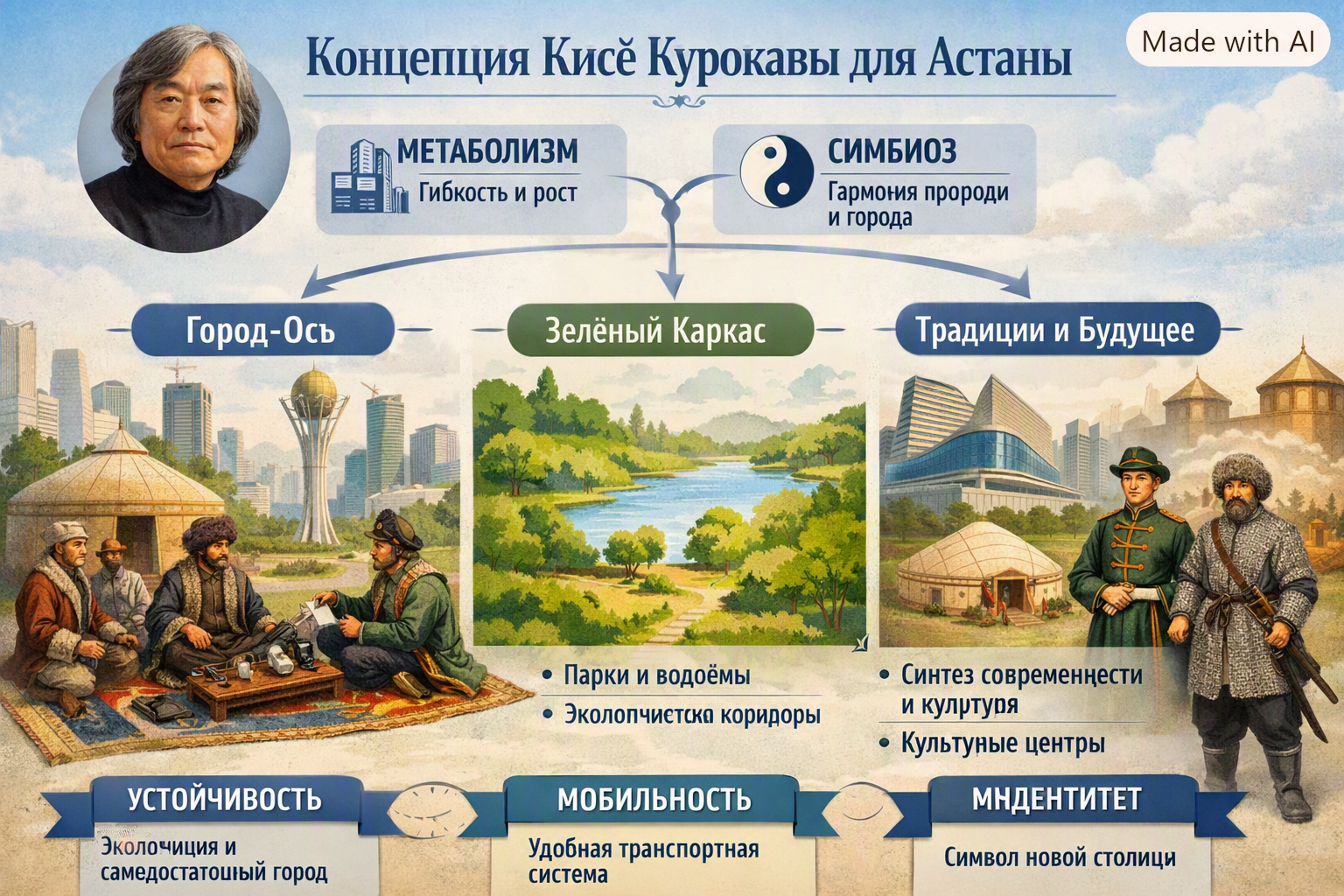
The history of the development of Kazakhstan’s modern capital, the city of Astana (formerly Akmola), is a multifaceted and highly diverse subject of academic research. One of the most significant aspects of this process is the formation of the city’s architectural character in the second half of the 1990s, when the Government of Kazakhstan decided to hold a competition for a conceptual design for the master plan for the development of the new centre of Kazakhstan’s capital, the city of Akmola (now Astana). The purpose of this study is to conduct a comprehensive examination of the process of organising this international competition, as well as to identify the fundamental role played by the ‘metabolist city’ project by the eminent Japanese architect Kisho Kurokawa in shaping the contemporary architectural and urban landscape of Astana. Objectives: To examine the historical background and conditions surrounding the international competition, following which the organisers were to select a design whose conceptual idea was to form the basis for the capital’s urban development. To analyse the conceptual provisions of the master plan, reflecting the philosophical approach of the competition’s winner. To highlight the distinctive features of K. Kurokawa’s urban planning concept, which envisaged the creation of a dynamically developing city capable of responding flexibly to changing social, economic and demographic challenges. To examine the impact of the proposed planning solutions on the spatial organisation of the new capital and the development of its transport infrastructure systems of public spaces and the monumental architectural ensemble of the administrative centre. To assess the extent to which the original concept has been realised in practice and the influence of Kisho Kurokawa’s creative legacy on contemporary architectural practice in Kazakhstan in the context of the city’s ongoing development. Materials and methods: The study is based on an examination of documents from the National Archives of the Republic of Kazakhstan, as well as documentary and academic literature on the subject of the study. Results. Based on an in-depth analysis of academic literature, archival materials, competition documentation and other data, the author draws a well-founded conclusion regarding K. Kurokawa’s significant contribution to the development of Astana’s architectural character. It is noted that, despite natural changes and adjustments to his design, the key ideas of the Japanese architect – relating to the creation of a symbiotic city and the preservation of the principle of harmonious coexistence between the urban and natural environments, in which green spaces were to coexist alongside the development of the city’s infrastructure and recreational areas for the capital’s residents – remained intact. Conclusion. The victory of the project by Kisho Kurokawa Architect & Associates laid a solid foundation for the formation of Astana’s modern identity. Studying the experience of implementing his project is of great theoretical and scientific value for researchers of the history of the formation of the architectural and urban landscape of the current capital of Kazakhstan.
Downloads
References
Alpyspayeva G.A. Astana v novoe i noveishee vremia. Astana. 2008. 276 p.
Alpyspayeva G.A., Sayakhimova Sh.N., Tuksaitova R.O. Kulturnoe prostranstvo Akmoly, Tselinograda, Astany: istoriia stanovleniia i razvitiia. Edited by G.A. .Alpyspayeva. Astana: S. Seifullin “KATU” JSC. 206 p.
Arkhitektura i stroitelstvo Kazakhstana: A Photo Book. Almaty: "Zolotaya Kniga" Editorial Office. 2004. 488 p.
Badlueva V. Filosofiia simbioza Kise Kurokavy. Bulletin of Tomsk State University. 2009. No. 329, pp. 61–64.
Blagovidova N., Ivanova O. Semanticheskii aspekt formirovaniia identichnosti arkhitekturno-prostranst-vennoi sredy novykh gorodov-stolits. Part 2: Continuity and Identity. Academia. Architecture and Construction. 2024, No. 1, pp. 147–158.
Dadyrova A.A., Mukhtarova G.S., Omarova Zh.N. Ontologiia stolitsy Kazakhstana: kvintessentsiia traditsii i sovremennosti. Balandin Readings. 2020, Vol. 15, pp. 314–322.
Dirksen L. Kharakter vzaimodeistviia ekologii kultury i ekologicheskogo soznaniia v deiatelnosti budushchikh dizainerov. International Journal of Applied and Fundamental Research. 2016, No. 7-3, pp. 469–474.
Dosmagambetov B. Zvezda Astany na nebosklone mirovykh stolits. (V sootvetstvii s gradostroitelnymi i arkhitekturnymi standartami XXI veka). Вulletin: Zodchiy. 21st Century. 2011, No. 4(41), pp. 16-27.
Zakirova Yu., Khakimova T. Vliianie futurologicheskikh kontseptsii na gradostroitelnoe planirovanie XX-XXI вв. News of the Kazan State University of Architecture and Engineering. 2018. No. 1(43), pp. 112–119.
Ivanova O.A. Osobennosti formirovaniia arkhitekturnogo obraza Astany - novoi stolitsy Kazakhstana. Bulletin of the V.G. Shukhov Belgorod State Technological University. 2017. No. 2, pp. 97–105.
Ilyasova K.M., Bagdatova S.A. Astana – novaia stolitsa: Supplementary Study Астана: Guide. Astana: "Tipografiya Stimul". 2017. 340 p.
Ippolitov S. Promyshlennyi dizain i arkhitektura Respubliki Kazakhstan: natsionalizatsiia vizualnoi sredy. Artistic Heritage: Research, Restoration, Preservation. 2023. No. 2(6), pp. 43–56.
Kravchenko V., Pershina I. The Architectural Metabolism of Kisho Kurokawa. In: The Future of Science – 2013: Proceedings of the International Youth Scientific Conference. Kursk, April 23–25, 2013. Executive: Gorokhov. Vol.2. Kursk: "Universitetskaya Kniga" CJSC. 2013. Pp. 149–151.
Mataibekov Sh. Arkhitektura Astany: poisk, idei, napravleniia razvitiia v XXI veke. Architecture. Construction. Design. 2006. No.1(42), рр. 16-23.
Muldagalieva A., Mamedov S., Musabaev T., Barakbaev A. Osnovnye problemy gradostroitelnogo planirovaniia goroda Astany (v kontekste generalnogo plana K.Kurokavy). Bulletin of L.N. Gumilyov Eurasian National University. Series: Technical Sciences and Technologies. 2024. No. 4(149), pp. 215–230.
Nazarbayev N.A. V serdtse Evrazii. Almaty: Atamura. 2005. 192 p.
Neshchadim M., Samoylov K. Formation of K. Kurokawa’s creative approach to form-making. Science. and Education Today. 2021. No.1(60), pp. 89–93.
Neshchadim M.E., Samoylov K.I. Characteristic form-making techniques in K. Kurokawa’s projects from various periods of his career. Prosperity of Science. 2022. No. 5(11), pp. 70–80.
Protokol №3 zasedaniia pravitelstvennoi komissii po provedeniiu mezhdunarodnogo konkursa na еkiz-ideiu generalnogo plana razvitiia novogo tsentra goroda Akmoly. In: Capitals of Kazakhstan Collection of Documents and Materials. Astana. 2008. No. 135. Pp. 183–185.
Redkin G. Ulitsa imeni Kise Kurokava. Publication date: February 15, 2013. URL: https://avestnik.kz/ ulitsa-imeni-kise-kurokava/?ysclid=mruvn584qr51017094.
Tabys T., Maulenova G., Samoylov K. Arkhitekturnye osobennosti administrativnogo tsentra Astany: regionalnyi Astany: regionalnyi analiz. Science and Education Today. 2023. No. 3(77), pp. 36–40.
Tyurin S., Nazarov Yu., Kornilova A. Formirovanie khudozhestvenno-kommunikatsionnoi sredy goroda Astany v kontekste realizatsii gradostroitelnogo proekta Kise Kurokavy. Academia. Architecture and Construction. 2018. No. 3, pp. 100–106.
Uchastniki mezhdunarodnogo konkursa na eskiz-ideiu generalnogo plana novogo tsentra goroda Akmoly. In: The Capital of Kazakhstan: Collection of Documents and Materials. Astana, 2008. No. 126. Pp. 164–172.
Downloads
Published
Issue
Section
License
Copyright (c) 2026 K. Akanov

This work is licensed under a Creative Commons Attribution-NonCommercial-NoDerivatives 4.0 International License.