From Chinese Sources to Kazakhstani Textbooks: Mechanisms of Knowledge Selection and Transformation Concerning the Ulus of Jochi
Research Article
DOI:
https://doi.org/10.65076/Keywords:
Ulus of Jochi, Golden orde, school textbook, historical memory, Chinese sources, historiography, history educationAbstract
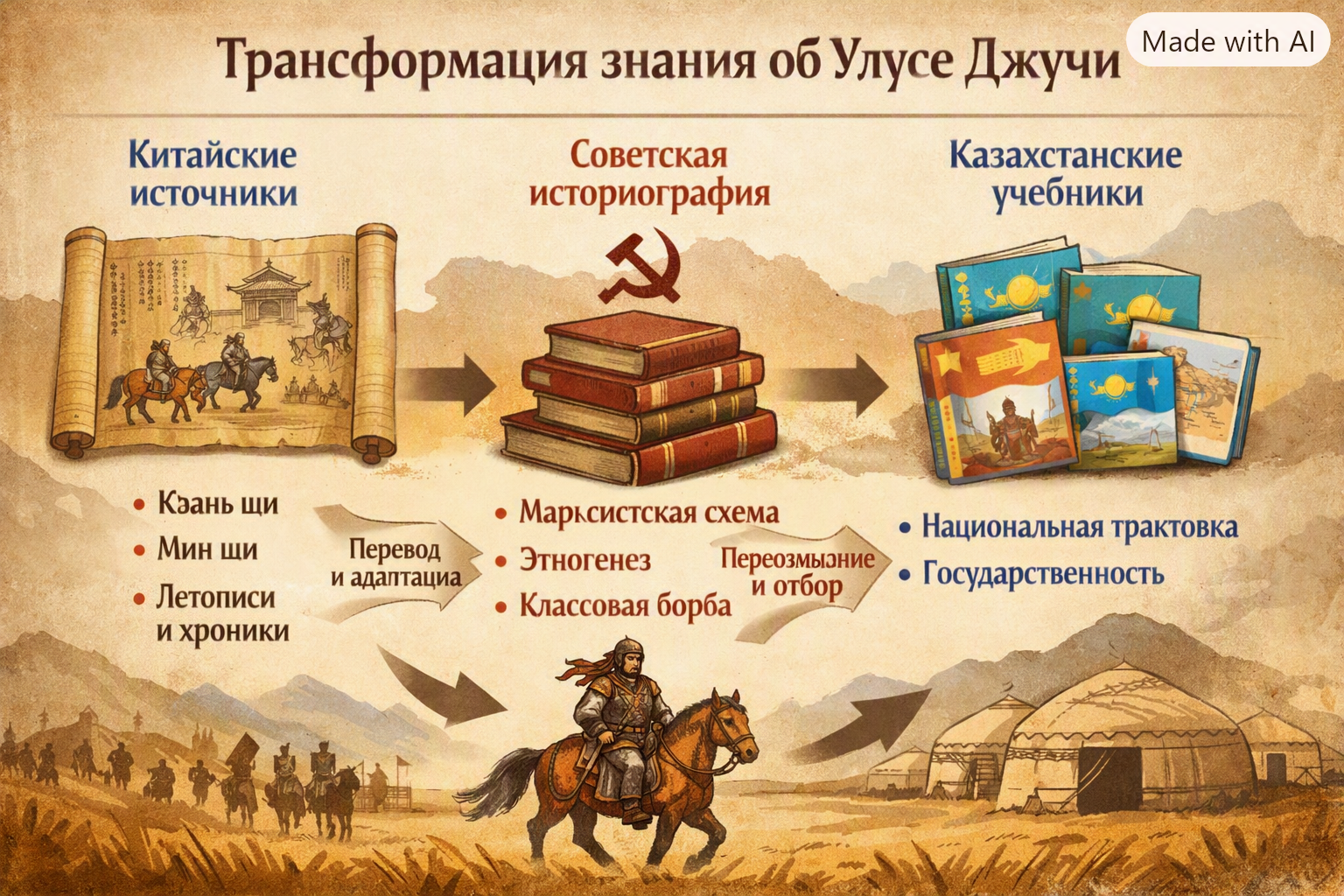
The article examines not the “image of the Ulus of Jochi” as such, but the mechanism through which it is transformed from heterogeneous source material into a connecting element of the school narrative of Kazakh statehood. The research problem lies in the fact that studies of Kazakhstani history textbooks convincingly demonstrate an emphasis on historical continuity, while the mechanism through which external written testimonies, academic reconstructions, and state educational frameworks are transformed into textbook narratives and incorporated into a coherent model of historical interpretation remains considerably understudied. The aim of the study is to reconstruct this mechanism through a comprehensive analysis of Chinese and Qing sources, educational literature, historiographical studies, and materials on the history of school education. The methodological framework combines source criticism, comparative historiographical analysis, narrative analysis, and conceptual analysis, enabling a comparison of the characteristics of source representations with their subsequent forms of academic and educational interpretation. The study demonstrates that the transformation of historical knowledge does not occur through a simple “retelling” of sources, but through three successive operations: a shift in perspective, from external administrative representation to internal social function; a shift in scale, from an individual episode or institution to a long-term trajectory of historical continuity; and a shift in the explanatory model, from dependency and situational diplomacy to political agency and statehood. As a result, the Ulus of Jochi acquires, within the school narrative, the function of a connecting link between the Kipchak milieu, Chinggisid legitimacy, and the history of the Kazakh Khanate. The study demonstrates that this transformation involves the selection, reduction, and reinterpretation of source information, the recontextualization of evidence, and the incorporation of particular elements of the past into a broader model of historical continuity. The scholarly novelty of the study lies in developing a model of three operations of historical knowledge transformation that makes it possible to trace the transition from source testimony to its representation in textbooks, as well as in distinguishing claims supported by historiography and the available corpus of sources from those requiring direct verification against specific textbook editions and archival materials. The textbook is thus conceptualized as an institution of selection and recoding of historical knowledge rather than as a passive reflection of academic historiography.
Downloads
References
Burkhanov A, Sharipova D. New Narratives and Old Myths: History Textbooks in Kazakhstan. Nationalities Papers. 2024. No.52(5), рр.1193-1208. DOI: https://doi.org/10.1017/nps.2023.64
He Xingliang, 1999a – He Xingliang Zhong Qingdai kanfen Zhong-E bianjie dachen de yi jian man wen wenshu yanjiu 清代勘分中俄边界大臣的一件滿文文书研究 [A Study of the Manchu Document by the Qing Dynasty Minister in Charge of Delimiting the Sino-Russian Border]. Minzu yanji 民族研究 [Ethnic Studies]. 1999, no.1, pp.79-88.
Kissane C. “History Education in Transit: Where to for Kazakhstan?” Comparative Education. 2005. No.41(1), рр.45–69. DOI:10.1080/03050060500073249.
Klyuchareva V. From the kazakh ssr to «independent» Kazakhstan: a history textbook as a way of forming national identity. Vestnik Altaiskogo Gosudarstvennogo Pedagogiceskogo Universiteta. 2022. No.2(51), рр.96-101 https://doi.org/10.37386/2413-4481-2022-2-96-102
Muminov N., Kuranbek A., Orynbayev Z. «The Problem of Ontological Security and Representation of Kazakh Statehood in School History Textbooks». Studies in Ethnicity and Nationalism 2026. Vol.26, no.1, рр.141–154. DOI: https://doi.org/10.1111/sena.70011.
Noda J. The Kazakhs, 16th-19th Centuries (26 May 2021), in David Ludden (ed.). Oxford Research Encyclopedia of Asian History (New York, NY, online edn, Oxford Academic, 27 Feb. 2017) https://doi.org/10.1093/acrefore/9780190277727.013.317
Shakiyeva A. Study of the history of the Jochi Ulus in the period of independent Kazakhstan. Bulletin of the L.N. Gumilyov Eurasian National University Historical sciences Philosophy Religion Series. 2022. No.138(1), рp.126–141. https://doi.org/10.32523/2616-7255-2022-138-1-126-141
Shakiyevа A.S. Features of Coverage of the Ulus Jochi History in the «Histories of the Kazakh SSR» in the 1940s-1950s. Golden Horde Review. 2023. Vol.11, no.1, рр.220-241. doi:10.22378/2313-6197.2023-11-1.220-241
Zhang Xintai, He Ling - Zhongguo Xinjiang lishi wenhua guji wenxian ziliao yibian. Hasakezu (er) 中国新疆历史文化古籍文献资料译编. 哈萨克族(二)[Chinese-Xinjiang Series of Translations of Ancient Historical and Cultural Textual Materials. Kazakh Nationality. Vol. 2]. Zhang Xintai, He Ling (eds.). Wulumuqi: Xinjiang Renmin Chubanshe, [year not indicated].
Published
Issue
Section
License
Copyright (c) 2026 Zh. Smakhanova

This work is licensed under a Creative Commons Attribution-NonCommercial-NoDerivatives 4.0 International License.