
Kazakh-Bashkir relations from the mid-eighteenth to the early nineteenth century
Research Article
DOI:
https://doi.org/10.65076/Keywords:
Kazakhs, Bashkirs, Middle Zhuz, Junior Zhuz, Orenburg frontier administration, Batyrsha uprising, Pugachev uprising, political interaction, ethnic contactsAbstract
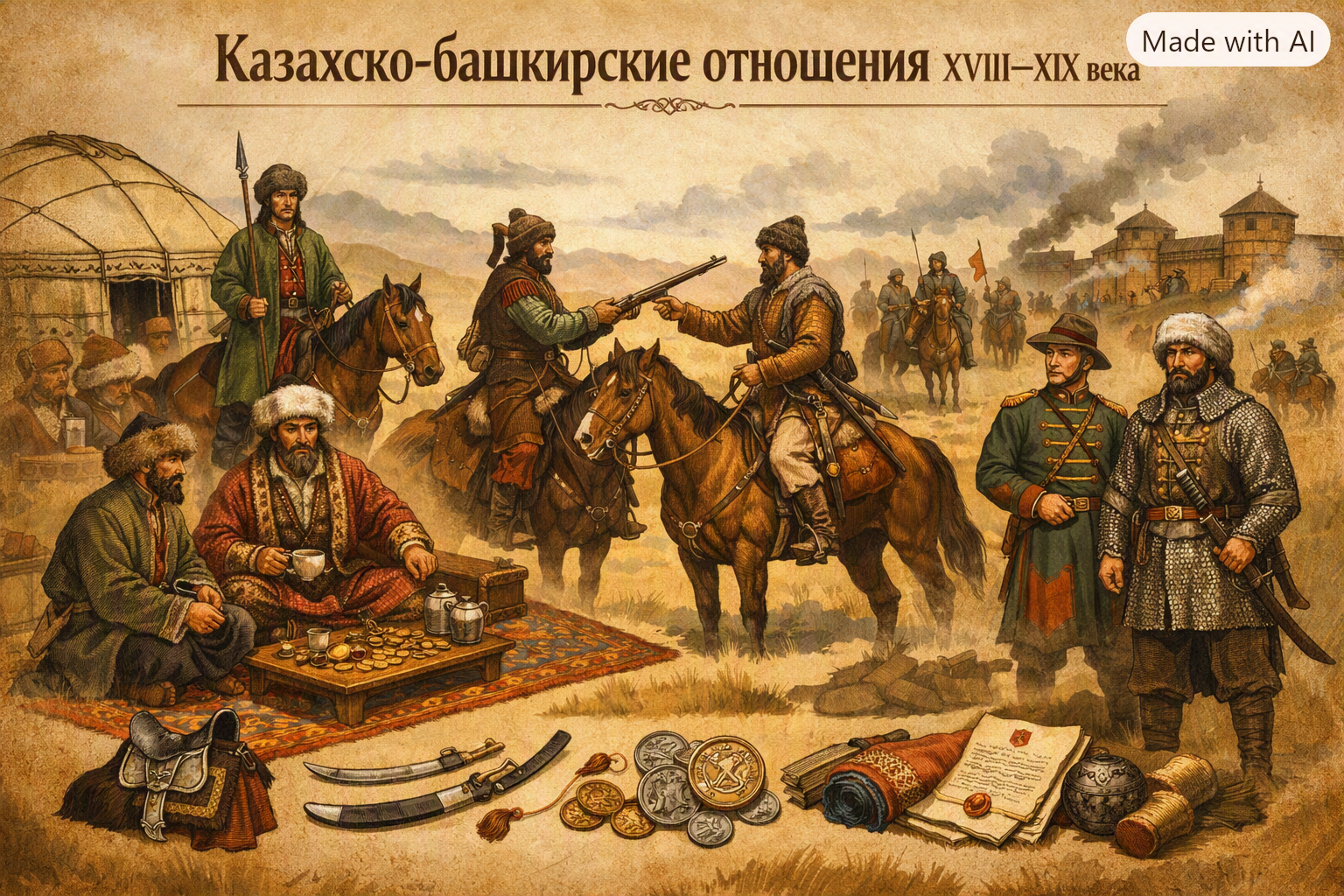
Kazakh-Bashkir relations from the mid-eighteenth to the early nineteenth century developed across the Southern Urals, the Cis-Urals, and the north-western Kazakh steppe, where customary migration routes, kinship ties, and a shared Islamic environment intersected with the expansion of Russian frontier lines. The subject requires an approach that treats relations between the two peoples not as a sequence of isolated clashes, but as a changing system of political cooperation, competition, administratively induced conflict, and migration. Aim and objectives. The study aims to identify the principal forms and stages of Kazakh-Bashkir interaction and to determine how the Orenburg frontier administration affected their development. It compares evidence on agreements reached before the uprising of 1755, Kazakh involvement in the events of 1773–1775, and migratory processes from the late eighteenth to the first third of the nineteenth century. Materials and methods. The source base includes published documents, materials from the Senate Archive, and archival files held in Ufa, Moscow, Orenburg, and Almaty. The research employs comparative historical and problem-chronological methods together with external and internal source criticism. Official reports are compared with historiographical interpretations, statistical records, and clan genealogical traditions. Results. The evidence indicates that representatives of Bashkir volosts and the Middle Zhuz discussed mutual support in the autumn of 1754, but the mass flight of Bashkirs into the Kazakh steppe in 1755 did not produce a stable military-political alliance. Pressure exerted by Orenburg governor Ivan Neplyuev on Khan Nuraly, attempts to surrender refugees, and the ensuing armed clashes deepened mutual estrangement. During the Pugachev uprising, channels of communication were restored largely through Bashkir elders acting as intermediaries, while the participation of Kazakh detachments remained local and depended on individual sultans. By the late eighteenth and early nineteenth centuries, migration had become the most visible form of interaction: alongside the return of Bashkirs from the steppe, increasing numbers of Kazakh families settled on Bashkir lands and were incorporated into the Bashkir estate. Conclusions. Kazakh-Bashkir relations developed non-linearly through alliances, armed conflict, mutual adaptation, and ethno-social integration. Russian frontier administration did not terminate contacts between neighboring communities, but substantially reshaped their channels, legal forms, and political consequences.
Downloads
Published
Issue
Section
License
Copyright (c) 2026 R. Asilguzhin

This work is licensed under a Creative Commons Attribution-NonCommercial-NoDerivatives 4.0 International License.